The Ultimate MSP Stack 2026: Tools Every Managed Service Provider Should Use

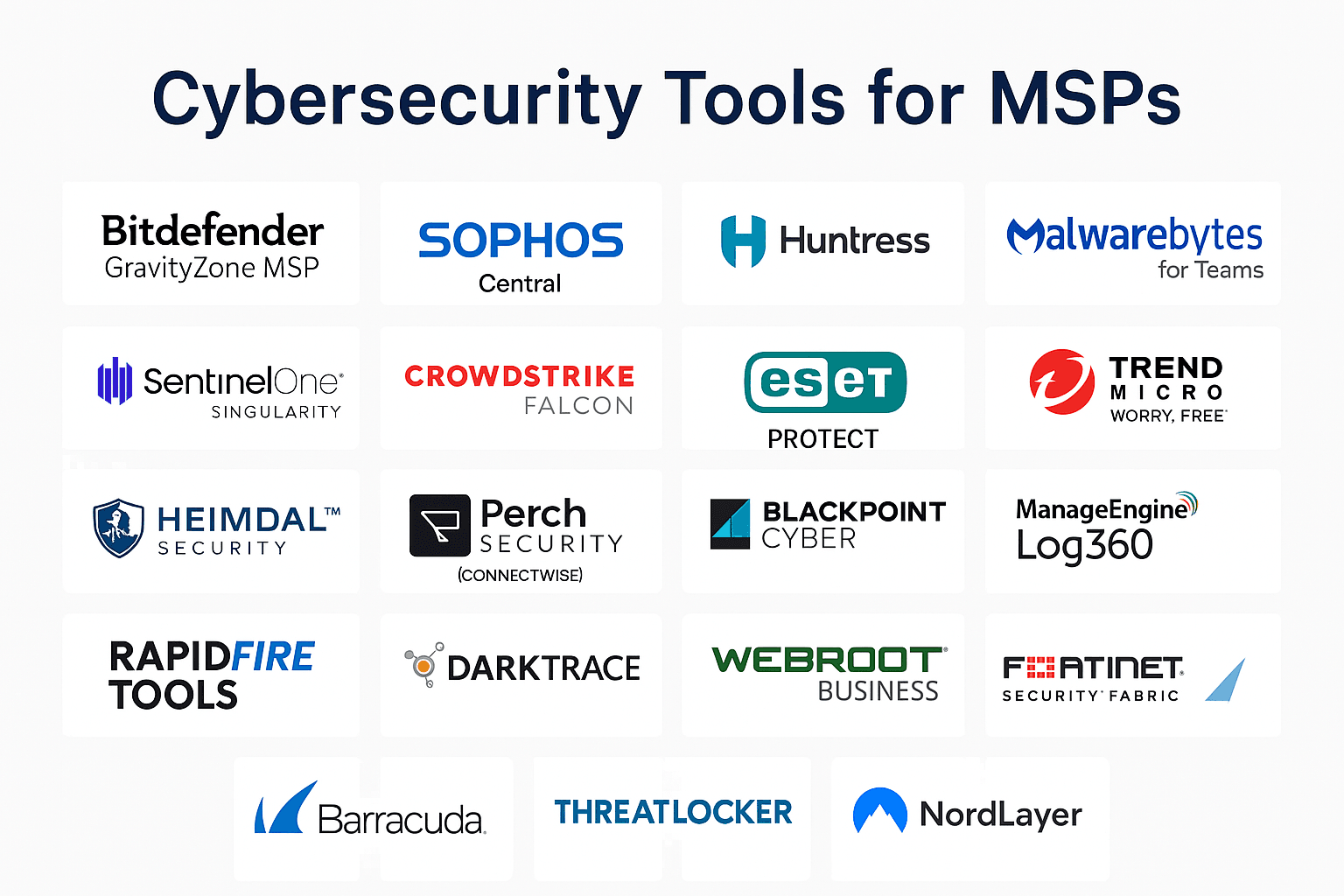
The tools an MSP uses determine the quality of service they deliver. A provider running outdated RMM software, consumer-grade antivirus, and a shared inbox for ticketing will never match the response times, security posture, or operational maturity of one running a modern, integrated stack.
This guide breaks down every layer of the MSP technology stack in 2026 — what each tool category does, the leading platforms, real pricing, and the integration points that matter. Whether you're an MSP building your stack, a business evaluating MSP providers, or an IT leader considering white-label MSP partnerships, this is the reference you need.
Layer 1: Remote Monitoring and Management (RMM)
RMM is the foundation of every MSP operation. These platforms deploy lightweight agents on managed endpoints (workstations, servers, network devices) that continuously report health metrics, enable remote access, automate routine tasks, and execute patches.
Leading RMM Platforms
| Platform | Best For | Pricing (per endpoint/mo) | Key Differentiator |
|---|---|---|---|
| ConnectWise Automate | Large MSPs (1000+ endpoints) | $3–$6 | Deep scripting, automation engine |
| NinjaOne (NinjaRMM) | Mid-size MSPs, ease of use | $3–$5 | Fastest deployment, intuitive UI |
| Datto RMM | MSPs in the Kaseya/Datto ecosystem | $2.50–$4.50 | Tight BCDR integration |
| Syncro | Small MSPs, startups | $139/tech/mo (unlimited endpoints) | All-in-one RMM+PSA, flat pricing |
| N-able N-sight | MSPs needing granular network monitoring | $2–$4 | SNMP monitoring, NetPath |
What to look for: Cross-platform support (Windows, macOS, Linux), built-in remote access (not a separate license), automated patch management with approval workflows, and a scripting engine for custom automation. If the RMM doesn't support macOS and Linux endpoints natively, you'll need supplemental tools for mixed environments.
The RMM platform is the backbone of your NOC operations — every alert, every automated remediation, and every health dashboard depends on it.
Layer 2: Professional Services Automation (PSA)
PSA platforms handle the business side — ticketing, time tracking, billing, SLA management, project management, and client communication. If RMM is the technical engine, PSA is the operational brain.
Leading PSA Platforms
| Platform | Best For | Pricing | Standout Feature |
|---|---|---|---|
| ConnectWise PSA (Manage) | Established MSPs | $35–$65/user/mo | Deepest feature set, massive ecosystem |
| HaloPSA | Growing MSPs, modern UI | $29–$49/user/mo | ITIL-aligned, excellent reporting |
| Autotask (Datto) | Datto ecosystem MSPs | $30–$55/user/mo | Native Datto RMM integration |
| Syncro | Small MSPs wanting simplicity | Included in RMM price | Unified RMM+PSA, no integration needed |
| SuperOps.ai | AI-forward MSPs | $59–$99/tech/mo | AI ticket triage, unified platform |
Critical integration: The PSA must bi-directionally sync with your RMM. When the RMM detects a disk failure, it should auto-create a P2 ticket in the PSA, assign it to the right queue, and start the SLA clock. If your technicians are manually creating tickets from RMM alerts, you're burning labor on a solved problem.
Layer 3: Endpoint Security (EDR / XDR / MDR)
Traditional antivirus died years ago. Modern endpoint protection uses behavioral analysis, machine learning, and cloud-based threat intelligence to detect and respond to threats that signature-based AV misses entirely. In 2026, if your MSP runs anything less than EDR with managed detection and response (MDR), they're operating with inadequate security.
Leading Endpoint Security Platforms
| Platform | Type | Per Endpoint/Mo | Key Capability |
|---|---|---|---|
| SentinelOne | XDR + MDR available | $4–$8 | Autonomous AI response, rollback capability |
| CrowdStrike Falcon | EDR + MDR (Falcon Complete) | $6–$15 | Threat intelligence, identity protection |
| Microsoft Defender for Endpoint | XDR (Defender XDR suite) | Included in M365 E5 | Native M365/Azure integration |
| Huntress | MDR for MSPs | $3–$5 | Human-led threat hunting, MSP-specific |
| Bitdefender GravityZone | EDR + risk analytics | $2.50–$5 | Patch management, risk scoring |
For MSPs managing Microsoft 365 environments, Microsoft Defender for Endpoint (included in E5 licensing) provides compelling value — native integration with Entra ID, Intune, and Microsoft Sentinel for unified XDR across endpoints, email, identity, and cloud. For MSPs that aren't all-in on the Microsoft stack, SentinelOne and Huntress are the dominant choices in the channel.
Read more about endpoint security requirements in our security compliance overview.
Layer 4: Security Information and Event Management (SIEM / SOC)
SIEM platforms aggregate logs from every system in the environment — firewalls, endpoints, servers, M365, Azure — correlate events, and identify threats that single-system monitoring would miss. Running a SIEM effectively requires a security operations center (SOC) with trained analysts who investigate alerts, tune detection rules, and respond to incidents.
SIEM Options for MSPs
| Platform | Deployment | Monthly Cost (100 users) | Best For |
|---|---|---|---|
| Microsoft Sentinel | Cloud (Azure) | $500–$2,000 (log volume based) | Microsoft-centric environments |
| Arctic Wolf | Managed SOC service | $2,000–$5,000 | MSPs without internal SOC analysts |
| Blumira | Cloud SIEM | $600–$1,500 | SMB-focused, automated response |
| Todyl SASE + SIEM | Unified platform | $8–$12/user/mo | Combined SIEM+SASE+EDR |
Many MSPs don't run their own SOC — they white-label security operations from a specialized provider. This makes economic sense. Building an internal SOC requires 4-6 analysts for 24/7 coverage at a labor cost of $400,000-$600,000/year. White-labeling SOC services costs a fraction of that and provides access to analysts who specialize in threat detection across hundreds of client environments.
Layer 5: Backup and Disaster Recovery (BCDR)
Backup is the last line of defense. When ransomware encrypts everything, when a server dies, when someone deletes the wrong SharePoint library, backup is what stands between "bad day" and "business-ending event."
BCDR Platforms
| Platform | Strength | Pricing Model |
|---|---|---|
| Veeam | Virtualization backup, Azure/AWS integration | Per workload/year |
| Datto BCDR / SIRIS | Instant virtualization, cloud failover | Appliance + cloud storage |
| Axcient x360Recover | MSP-specific, chain-free backup | Per protected TB |
| Acronis Cyber Protect Cloud | Backup + EDR in one agent | Per workload/mo |
| Druva | SaaS backup (M365, Google Workspace) | Per user/mo |
Critical distinction: SaaS data (Microsoft 365, Google Workspace) needs separate backup. Microsoft's native retention policies are not backup — they're compliance tools with limited recovery capabilities. If a user permanently deletes a SharePoint site and empties the recycle bin, Microsoft won't help you after 93 days. You need a third-party backup solution like Veeam for M365, Druva, or Spanning.
Backup architecture matters significantly for HIPAA-compliant environments and PCI-DSS hosting where data residency and encryption requirements add complexity.
Layer 6: Documentation and Password Management
Documentation is the most underrated layer of the MSP stack. Without it, every technician starts from scratch on every ticket. Knowledge walks out the door when staff leaves. Disaster recovery procedures exist only in someone's memory.
Documentation Platforms
| Platform | Key Features | Pricing |
|---|---|---|
| IT Glue | SOC 2 compliant vault, automated asset docs, runbooks | $29–$39/user/mo |
| Hudu | Self-hosted option, modern UI, API-first | $23–$35/user/mo |
| Passportal (N-able) | Password management + documentation | $2–$4/user/mo |
The documentation platform should integrate with your RMM (auto-populate device info), your PSA (link documentation to tickets), and include a SOC 2 compliant password vault. If your MSP stores client passwords in a shared spreadsheet or a consumer password manager, that's a security incident waiting to happen.
Layer 7: Email Security
Email remains the #1 attack vector. Over 90% of cyberattacks begin with a phishing email, according to CISA's 2024 threat landscape report. Native Microsoft 365 email filtering (Exchange Online Protection) catches commodity spam but misses sophisticated phishing, business email compromise (BEC), and targeted spear-phishing attacks.
Email Security Platforms
| Platform | Approach | Per User/Mo |
|---|---|---|
| Proofpoint Essentials | Gateway + post-delivery protection | $2–$4 |
| Avanan (Check Point) | API-based, catches post-delivery threats | $4–$6 |
| Microsoft Defender for Office 365 | Native M365 integration | Included in M365 E5 / P2 add-on |
| IRONSCALES | AI + crowdsourced phishing detection | $3–$6 |
For MSPs managing large Microsoft 365 deployments, the decision often comes down to Microsoft Defender for Office 365 Plan 2 (included in E5, or $5/user/month as an add-on) versus a third-party solution. Microsoft's native solution has improved dramatically and now includes Safe Links, Safe Attachments, and automated investigation — competitive with dedicated email security vendors.
Layer 8: Identity and Access Management
Identity is the new security perimeter. In a world where employees work from home, coffee shops, and client sites, the corporate firewall is irrelevant — what matters is who's authenticating and from where.
- Microsoft Entra ID (Azure AD): The identity backbone for Microsoft 365 and Azure environments. Conditional Access policies enforce MFA, block risky sign-ins, and restrict access based on device compliance, location, and risk level. Included in M365 Business Premium and E3/E5.
- JumpCloud: For non-Microsoft environments or heterogeneous shops. Cross-platform directory (Windows, macOS, Linux), SSO, device management, and conditional access. $7-$15/user/month.
- Duo Security (Cisco): MFA and zero-trust access. Often used as an overlay on top of Entra ID for additional access controls. $3-$9/user/month.
Every MSP should enforce MFA on 100% of user accounts as a non-negotiable baseline. In 2026, passwordless authentication (FIDO2 security keys, Windows Hello for Business, Microsoft Authenticator passkeys) is the direction the industry is moving. MSPs should be migrating clients toward passwordless, not just adding MFA to passwords.
Layer 9: Network Security and SASE
The network perimeter has dissolved. With remote work, cloud applications, and mobile devices, the traditional "firewall at the office" model is insufficient. Secure Access Service Edge (SASE) combines network security functions — firewall, secure web gateway, CASB, zero trust network access — into a cloud-delivered service.
- Todyl: Built specifically for MSPs. Combines SASE, SIEM, EDR, and governance in a single platform. $8-$12/user/month.
- Perimeter 81 (Check Point): Zero trust network access, SDP, cloud firewall. $8-$12/user/month.
- Zscaler: Enterprise-grade SASE. Typically for larger deployments (500+ users). Contact for pricing.
- Fortinet FortiSASE: Leverages Fortinet's security fabric. Good fit for MSPs already running FortiGate firewalls. Contact for pricing.
For physical office locations, traditional firewall management remains necessary — Fortinet FortiGate, Palo Alto, SonicWall, and Sophos are the leading platforms for SMB/mid-market. But the firewall should complement a SASE solution, not replace it.
Layer 10: Cloud Management
MSPs managing client workloads in Azure, AWS, or Google Cloud need specialized tooling for cost optimization, security posture management, and governance:
- Nerdio Manager for Enterprise: Automates Azure Virtual Desktop (AVD) and Windows 365 management. Essential for MSPs delivering hosted desktop environments. $3-$5/user/month.
- CloudHealth (VMware) / Spot.io (NetApp): Multi-cloud cost optimization — identifies waste, right-sizes VMs, recommends reserved instances. Critical for Azure and AWS cost management.
- Microsoft Azure Lighthouse: Free. Enables MSPs to manage multiple Azure tenants from a single control plane using delegated access. Every MSP managing Azure clients should use this.
- CIPP (CyberDrain Improved Partner Portal): Free, open-source. Multi-tenant management for Microsoft 365 — user onboarding/offboarding, security baselines, license management across all client tenants from one dashboard.
Layer 11: AI and Automation (The 2026 Differentiator)
AI-powered automation is the layer that separates mature MSPs from the rest in 2026. The tools are moving fast:
- ConnectWise Sidekick: AI copilot for technicians — summarizes ticket history, suggests resolutions, drafts responses. Reduces average handle time by 20-30%.
- Microsoft Copilot for Security: AI assistant for SOC analysts — queries threat intelligence, analyzes incidents, generates investigation summaries. Integrated into Microsoft Sentinel and Defender XDR.
- Rewst: No-code automation platform built for MSPs. Automates onboarding workflows, ticket triage, compliance checks, and multi-system orchestration. $5-$10/user/month.
- Gradient MSP: Automates billing reconciliation — syncs license counts between vendor portals and PSA billing. Eliminates the "billing leakage" that costs the average MSP 5-8% of revenue.
AI isn't replacing MSP technicians in 2026. It's handling the L1 noise — password resets, ticket classification, knowledge base lookups — so human engineers focus on complex problems. MSPs that adopt AI tooling can handle 20-30% more endpoints per technician, directly improving margins.
The Complete Stack: What It Costs
Here's what a well-equipped MSP stack costs per managed endpoint per month:
| Layer | Tool Example | Per Endpoint/Mo |
|---|---|---|
| RMM | NinjaOne | $4.00 |
| PSA | HaloPSA | $1.50* |
| EDR | SentinelOne | $5.00 |
| SIEM | Blumira | $3.00 |
| Backup | Axcient | $4.00 |
| Documentation | Hudu | $1.00* |
| Email Security | Proofpoint | $3.00 |
| DNS Filtering | DNSFilter | $1.00 |
| Automation | Rewst | $2.00 |
| Total Tool Cost | $24.50/endpoint |
*PSA and documentation are per-technician costs, amortized across managed endpoints.
At $24.50 per endpoint in tooling costs, an MSP charging $150/user/month has roughly $125 to cover labor, overhead, and profit. With an average technician managing 150-200 endpoints, the math works — but only with efficient operations and smart automation. This is why tool selection and integration directly impacts MSP profitability.
Stack Architecture: How It All Connects
Individual tools are useless without integration. Here's how the modern MSP stack flows:
- RMM agent detects anomaly (disk at 95%, CPU sustained 100%, service stopped) → auto-creates ticket in PSA
- PSA auto-classifies ticket priority based on impact rules → assigns to queue → SLA clock starts
- EDR detects suspicious process → isolates endpoint automatically → creates P1 ticket in PSA → alerts SOC/SIEM
- SIEM correlates EDR alert with Azure AD sign-in from unusual location → escalates to human analyst
- SOC analyst investigates using documentation platform for client context → coordinates response
- Backup system receives automated restore request if ransomware confirmed → validates clean restore point → initiates recovery
- AI assistant drafts incident summary, client communication, and post-mortem documentation
When this automation chain works, the MSP resolves many incidents without human intervention. When it doesn't — because tools don't integrate, or automations aren't configured — technicians spend their time being middleware between disconnected systems.
Common Stack Mistakes MSPs Make
- Tool sprawl. More tools isn't better. Every additional tool is another login, another dashboard, another integration to maintain, and another vendor to manage. Consolidate where possible — platforms like Todyl (SASE+SIEM+EDR) and Syncro (RMM+PSA) reduce tool count.
- Skipping documentation. MSPs that skip documentation platforms pay the price in onboarding time (new technicians can't find anything), escalation delays (tribal knowledge locked in one person's head), and client transitions (no documentation to hand off).
- Running consumer-grade security. Consumer antivirus (Norton, McAfee, consumer Windows Defender) has no place in a managed environment. These products lack centralized management, EDR capabilities, and the threat intelligence that business-grade platforms provide.
- No backup testing. Having a backup tool isn't enough. If you're not testing restores monthly — actually spinning up a VM from a backup image and verifying data integrity — you don't have backup. You have a false sense of security.
- Ignoring the billing layer. MSPs lose 5-8% of revenue to billing leakage — licenses they're paying vendors for but not billing clients. Tools like Gradient MSP or manual monthly reconciliation catch this, but many MSPs never implement it.
Building vs. White-Labeling Your Stack
Not every MSP needs to build the entire stack in-house. White-label partnerships let MSPs offer enterprise-grade services without the overhead of building each capability:
- White-label NOC: 24/7 monitoring and alerting without hiring overnight staff
- White-label SOC: Security operations without building a SIEM team
- White-label cloud management: Azure/AWS expertise without hiring cloud architects
- White-label helpdesk: After-hours or overflow helpdesk capacity
- Staff augmentation: Dedicated system administrators, network engineers, or security analysts working under your brand
The math is straightforward: hiring a SOC analyst costs $90,000-$130,000/year, and you need at least 4 for 24/7 coverage ($400,000+). White-labeling SOC services for your client base costs a fraction of that. The same logic applies to NOC, helpdesk, and cloud management functions.
The 2026 MSP Stack Starter Kit
If you're building an MSP from scratch or modernizing an outdated stack, here's the minimal viable stack that delivers enterprise-grade service:
- Syncro (RMM + PSA in one platform) — $139/tech/month
- SentinelOne Complete (EDR with rollback) — $5/endpoint/month
- Huntress (MDR overlay) — $3/endpoint/month
- Axcient x360Recover (BCDR) — per protected TB
- Hudu (documentation + passwords) — $23/tech/month
- Proofpoint Essentials (email security) — $2/user/month
- DNSFilter (DNS security) — $1/user/month
- Microsoft 365 E5 or Business Premium (identity, compliance, Defender) — via CSP
This covers monitoring, security, backup, documentation, and email protection. Total tool cost: approximately $20-$25/endpoint/month. Layer in white-label NOC and SOC services when client count justifies it.
The MSP stack is never finished — vendors release updates quarterly, new categories emerge, and client requirements evolve. Review your stack annually. The MSP that runs a 2023 stack in 2026 is delivering 2023 service quality, regardless of what their marketing says.
Get the most comprehensive Microsoft 365 plan with advanced security, compliance, and analytics.
Compare M365 E5 FeaturesTopics
Sreenivasa Reddy G
Founder & CEO • 15+ years
Sreenivasa Reddy is the Founder and CEO of Medha Cloud, recognized as "Startup of the Year 2024" by The CEO Magazine. With over 15 years of experience in cloud infrastructure and IT services, he leads the company's vision to deliver enterprise-grade cloud solutions to businesses worldwide.
More in White Label MSP
View all
NinjaOne Alternatives — 7 RMMs Compared by an MSP That Runs Them (2026)
9 min read
SentinelOne Pricing — Singularity Tiers Per Endpoint, MSP Rates & CrowdStrike Math (2026)
7 min read
NinjaOne Pricing — What You'll Actually Pay Per Endpoint (MSP Operator Breakdown, 2026)
8 min read
55 Managed Services Market Statistics for 2026 — MSP Growth Data
20 min read
MSP Industry Statistics 2026: Market Size, Growth & M&A Data
16 min read
Kaseya Fires 250 People After 'Very Strong' 2025 — What MSPs Should Know
9 min read